Rally Legend Returns in Modern MINI
Last updated:
MINI 1965 Victory Special Edition: A Tribute to the Monte Carlo Giant-Killer
The MINI 1965 Victory Special Edition celebrates one of the most remarkable underdog victories in motorsport history, when a tiny Mini Cooper S shocked the world by winning the Monte Carlo Rally in 1965.
Against powerful rivals from Ford, Porsche and Mercedes-Benz, the small British saloon proved that agility, balance and clever engineering could outperform sheer horsepower on icy mountain roads.
More than sixty years later, MINI has revived that legendary moment with a limited edition model that blends rally heritage with modern performance.

For enthusiasts who admire the Mini’s rich story, this special edition is a reminder of the car that turned British ingenuity into motorsport folklore.
MINI 1965 Victory Special Edition – Quick Facts
What is the MINI 1965 Victory Special Edition?
The MINI 1965 Victory Special Edition is a limited-production model celebrating the Mini Cooper S victory at the 1965 Monte Carlo Rally. The edition features heritage styling inspired by the rally winner, including race number graphics and motorsport-themed interior details.
Why was the rally win important?
The victory proved that the small Mini Cooper S could defeat far more powerful rivals through agility, balance and clever engineering on icy Alpine rally stages.
How many will be built?
Production is extremely limited with just 45 cars planned for Canada.
What engines are available?
Buyers can choose between a Cooper S petrol version, a John Cooper Works model and a JCW electric variant.
When will it be available?
Expected arrival during 2026.

MINI 1965 Victory Special Edition Guide
The Rally Victory That Made the Mini Famous

Why the Mini Cooper S Shocked the Motorsport World
The 1965 Monte Carlo Rally remains one of the most famous moments in rally history.
Competitors arrived with larger engines and greater power, yet the Mini possessed advantages that proved decisive:
- front-wheel drive traction
- compact size for narrow mountain roads
- lightweight construction
- excellent balance through tight corners
Its compact dimensions allowed drivers to place the car precisely on narrow mountain roads. Front-wheel drive provided superb traction on icy surfaces. The lightweight body delivered quick responses through tight corners.
This clever engineering approach would influence generations of performance hatchbacks.

The rally stages of Monte Carlo rewarded balance and control rather than brute force, and the Mini’s design delivered exactly that.
While rivals wrestled heavier cars through snowy bends, Driver Timo Mäkinen and co-driver Paul Easter guided their Mini Cooper S through snow-covered mountain passes to secure a remarkable victory.
Their car carried race number 52, which the modern Victory Edition proudly references.
The Mini had already won the rally in 1964 with Paddy Hopkirk, yet the 1965 triumph firmly established the small British car as a motorsport legend.
Watching a compact saloon defeat larger and more powerful machines captured the public imagination.
Almost overnight, the Mini became one of the most celebrated cars in the world.
MINI 1965 Victory Special Edition Design

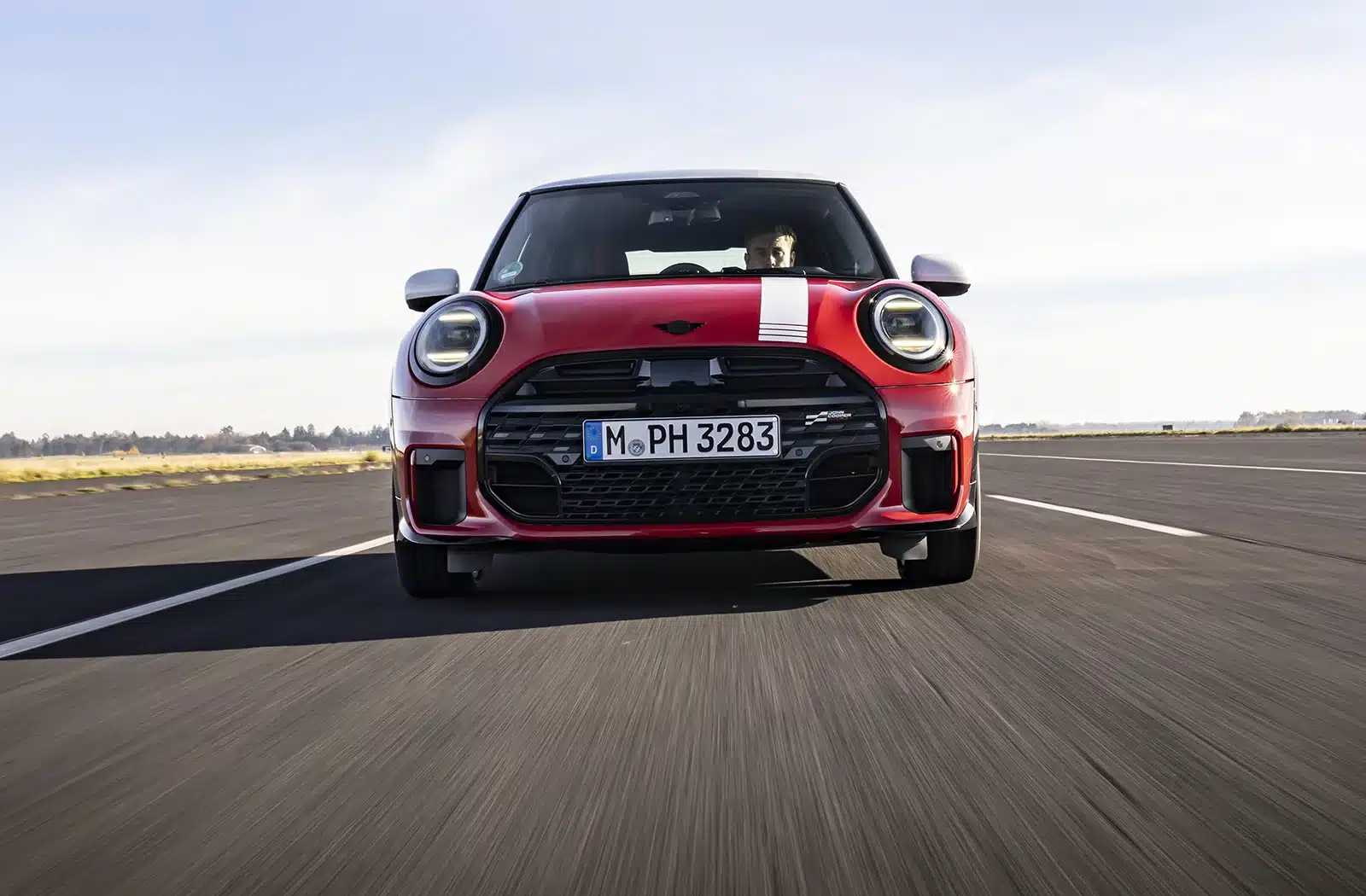
The MINI 1965 Victory Special Edition draws heavily from the appearance of the famous rally car.
Finished in Chili Red, the modern MINI echoes the colour scheme that became synonymous with the rally winner.
Several visual details celebrate the historic triumph.
Exterior highlights include:
- Chili Red paintwork
- white roof and mirror caps
- heritage bonnet stripe
- historic race number 52
- subtle reference to the rally registration AJB 44B
- distinctive 18-inch John Cooper Works alloy wheels
The styling manages a delicate balance. It honours the past without feeling overly theatrical.
Anyone familiar with the rally car will recognise the inspiration immediately.

Performance and Engine Options
The Victory Special Edition is available across several MINI performance models.
MINI Cooper S Victory Edition
The Cooper S version produces around 204 horsepower from a turbocharged four-cylinder engine and reaches 62 mph in roughly 6.6 seconds, making it quick enough to deliver the spirited driving character MINI owners expect.
MINI John Cooper Works Victory Edition
The JCW model increases power to around 231 horsepower, cutting the 0-62 mph sprint to about 6.1 seconds.
MINI JCW Electric Victory Edition
The electric version delivers around 258 horsepower and reaches 62 mph in under six seconds.
Regardless of the version chosen, MINI retains the lively handling and quick steering that define the brand.
Interior Features and Heritage Details

Inside the cabin, MINI adds subtle references to the rally legend.
Interior highlights include:
- 1965 Victory Edition door sill plates
- steering wheel badge with heritage emblem
- anthracite and red JCW trim
- commemorative graphics referencing the rally car

The interior celebrates the past while maintaining the comfort expected from modern MINI models.
Reaction From the Motoring World
The MINI is much loved, the launch of the Victory Special Edition has been welcomed warmly by enthusiasts and motoring journalists alike.
Many appreciate that MINI chose to celebrate a genuine motorsport achievement rather than inventing a nostalgic theme.
The Monte Carlo victories remain central to the brand’s identity.

Some critics note that the changes are largely cosmetic rather than mechanical. Even so, the visual tribute to one of the Mini’s greatest moments has proven popular with enthusiasts.
After all, when a small car once embarrassed the giants of rallying, it deserves to be remembered.
MINI Motorsport Heritage Timeline
Few small cars have enjoyed such an extraordinary motorsport story.
1959 – Birth of the Mini
Sir Alec Issigonis designs the original Mini as a practical response to the Suez fuel crisis.
1961 – Mini Cooper Introduced
Racing engineer John Cooper recognises the Mini’s performance potential and develops the Mini Cooper.
1964 – First Monte Carlo Rally Victory
Paddy Hopkirk wins the rally, instantly making the Mini famous.
1965 – Legendary Triumph
Timo Mäkinen and Paul Easter secure the most celebrated victory.
1967 – Third Rally Win
Rauno Aaltonen delivers another Monte Carlo triumph for the Mini.
2001 – MINI Reborn
BMW relaunches MINI with a modern interpretation of the classic car.
2026 – Victory Special Edition
MINI celebrates the rally legacy with the 1965 Victory Special Edition.
Could the Victory Edition Become a Future Classic?

Collectors often pay close attention to heritage editions.
The Victory Edition carries several qualities that appeal to enthusiasts.
Limited Production
Just 45 examples are planned for the Canadian market, making it one of the rarest modern MINI models.
Genuine Motorsport Heritage
The car celebrates one of the Mini’s greatest racing achievements.
Strong Enthusiast Community
MINI enjoys one of the most loyal owner communities in the motoring world.
Taken together, these factors suggest the Victory Edition could attract long-term interest from collectors.
MINI Mythbusters
Even among enthusiasts, a few myths persist about the Mini’s rally success.

Did the Mini really beat more powerful cars?
Yes. The Cooper S defeated rivals with much larger engines.
Were rally Minis heavily modified?
Not dramatically. The rally cars remained close to the road version.
Why did the Mini perform well on snow?
Front-wheel drive and a lightweight body delivered excellent traction.
MINI Buyer Insight

Many motorists considering a MINI wonder what ownership is like.
From years of covering performance cars and hot hatches, I can say the MINI tends to appeal to drivers who enjoy lively handling and distinctive character.
Driving Experience

MINIs remain among the most entertaining small cars on the road. Quick steering and compact proportions make them particularly enjoyable on twisting country roads.
Practicality
Despite their sporting image, most MINI models serve perfectly well as everyday transport. Rear space can be tight, yet owners usually accept the compromise.
Running Costs
Running costs resemble those of other premium small cars. Insurance and tyre wear may be higher on performance models.
Ownership Community
Perhaps the greatest attraction is the community surrounding the brand. MINI clubs and gatherings remain extremely active across Britain and Europe.
Why the Mini’s Rally Story Still Matters

The Mini’s Monte Carlo victories represent one of the greatest underdog stories in motorsport.
A small British car defeated machines with far greater power simply through clever engineering and remarkable agility.
Even today, enthusiasts admire that achievement.
The MINI 1965 Victory Special Edition keeps that story alive for a new generation of drivers.
A Small Car with an Enormous Legacy
The MINI 1965 Victory Special Edition is more than a commemorative model with a few heritage graphics. It is a celebration of one of the most charming and improbable success stories in motoring history.
When the original Mini first appeared in 1959, it represented something quite radical. Britain needed economical transport after the fuel shortages of the Suez crisis, and designer Sir Alec Issigonis responded with a car that was brilliantly clever rather than extravagantly powerful. By turning the engine sideways and pushing the wheels to the very corners of the body, he created a small car that offered remarkable interior space and nimble handling.
What nobody quite expected was that this modest little machine would soon become a motorsport hero.
That transformation came courtesy of John Cooper, who looked at the Mini and saw a racing car hiding in plain sight. The result was the Mini Cooper and later the Cooper S, which would go on to embarrass far more powerful rivals on the rally stages of Europe. The Monte Carlo Rally victories of the 1960s, especially the famous 1965 triumph, sealed the Mini’s reputation as the ultimate giant killer.
Even today, that story still raises a smile among enthusiasts.
The Famous “Go-Kart” Driving Experience
Ask anyone who has driven a MINI with enthusiasm and you will likely hear the same description repeated.
It feels like a go-kart for the road.
The steering is quick, the front end darts eagerly into corners and the compact dimensions make the car wonderfully easy to place on a twisting B-road.
Modern MINIs are obviously larger than the original, yet they still retain that eager, playful character that has become part of the brand’s identity.
It is the sort of car that encourages a driver to take the long way home.
Not recklessly, of course. Just… enthusiastically.
A Cultural Icon on Screen
The Mini’s appeal has never been limited to motorsport. It has also enjoyed a rather successful acting career.
Perhaps the most famous appearance came in the 1969 film The Italian Job, where a fleet of red, white and blue Minis danced through the streets, staircases and rooftops of Turin in one of the greatest car chase sequences ever filmed.
Even today, that scene still delights car enthusiasts and film lovers alike.
The Mini popped up again decades later in The Bourne Identity, where a humble little car unexpectedly outmanoeuvred larger vehicles in a memorable Paris chase.
Clearly, filmmakers understand what rally drivers learned long ago: a Mini is far more capable than its size suggests.
Why the Mini Still Matters
Cars come and go, fashions change and technology evolves, yet the Mini remains one of the most recognisable and beloved vehicles ever produced.
Part of that appeal comes from its personality. The Mini never tried to intimidate anyone with brute force. Instead it won people over with clever design, playful handling and just a touch of rebellious charm.
The MINI 1965 Victory Special Edition captures that spirit beautifully. It reminds us that sometimes the smallest car on the road can deliver the biggest grin.
A Personal Note
I will confess something here.
After decades of writing about supercars, luxury saloons and machinery with horsepower figures that would make a racing driver raise an eyebrow, I still find myself drawn back to the Mini.
Many years ago I borrowed a friend’s classic Mini Cooper for a weekend. It was not particularly fast, and the heater had the enthusiasm of a tired hairdryer. Yet on a winding country road the little car felt alive in a way that many larger machines simply do not.
At one point we arrived at a small village pub where several much grander cars were parked outside. Jaguars, a Porsche or two, and something Italian that looked as though it required regular emotional support.
As we climbed out of the Mini, a gentleman at the next table looked over the top of his newspaper and said, rather approvingly:
“Ah… you’ve brought the fun car.”
He was absolutely right.
That, in the end, is why the Mini remains such a favourite. It may be small, it may be cheeky, and it may occasionally feel as though it wants to turn every roundabout into a rally stage. But very few cars manage to combine history, character and pure driving enjoyment quite so effortlessly.
And if you ask me, that is a rather wonderful legacy for a little car that was originally designed simply to save petrol.
About the Author
Sean Neylon is an award-winning motoring journalist and automotive industry commentator with more than five decades of experience covering performance cars, motorsport, classic vehicles and emerging automotive technology. Over the years he has reported on everything from rally legends and iconic British sports cars to the latest high-performance supercars and electric performance models.
Renowned for his engaging storytelling and deep knowledge of motoring history, Sean brings an enthusiast’s perspective to every article, combining first-hand driving insight with decades of observation of the automotive world. His writing explores not only how cars perform, but why certain machines capture the imagination of drivers and enthusiasts across generations.
Sean has a particular passion for classic performance cars, rally heritage and the enduring appeal of iconic models such as the Mini Cooper, whose Monte Carlo Rally victories helped shape the identity of one of Britain’s most beloved automotive brands. His work continues to celebrate the engineering ingenuity, culture and driving enjoyment that make motoring such a compelling subject.
When he is not writing about cars, Sean can usually be found exploring winding country roads, preferably in something small, lively and eager to tackle the next corner.
Images: press.bmwgroup.com
Explore More MINI News, Performance and Heritage Stories
Like What You’ve Read?
For more articles like this, receive our weekly e-newsletter, including partner deals and all things motoring, register your email below.
Please note: You cannot subscribe to Smart-Motoring unless you put a tick in the checkbox below to indicate have read and agreed to our privacy policy.