Xiaomi Vision Gran Turismo: 1,900hp Phone Maker’s Hypercar

1,900 Horsepower, Magnetic Wheels That Don’t Spin, and Europe Firmly in Its Sights: This Is the Electric Hypercar Nobody Saw Coming
“The invitation itself was a recognition of what Xiaomi has achieved. It allowed our teams in Munich, Beijing and Shanghai to collaborate, to push boundaries, and to envision what a future hypercar could look like when designed without limits.” — Tianyuan Li, Design Head, Xiaomi EV
Xiaomi Vision GT: Navigating the Technology, Design, and Aerodynamics
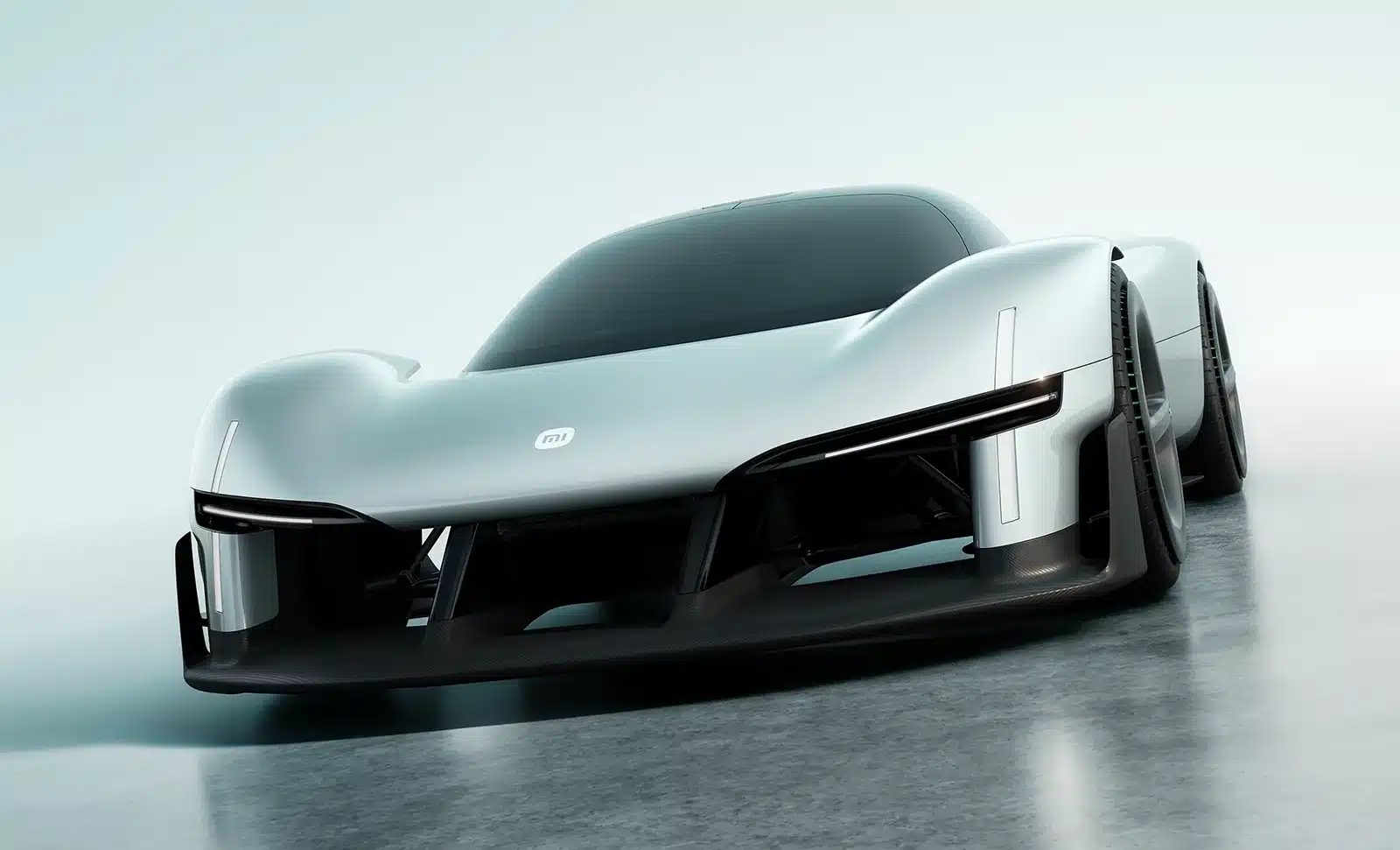
There is a moment, when you first lay eyes on the Xiaomi Vision Gran Turismo, when your brain quietly panics. It tries to file the shape away alongside things it already recognises. A Le Mans prototype, perhaps. A water droplet caught by a high-speed camera before gravity wins. Something from a studio lot in Burbank that required a £40 million CGI budget.
None of those files quite fit.

What you are actually looking at is a 1,900-horsepower electric hypercar concept, built by a company that, two years ago, was best known for making your mobile phone.
That fact alone should tell you a great deal about the speed at which the automotive world is being pulled apart and rebuilt.
The Xiaomi Vision Gran Turismo made its full public debut at Mobile World Congress 2026 in Barcelona on 28 February, and for once, the motoring world stopped scrolling long enough to pay proper attention.
Why You Should Take Xiaomi Completely Seriously
Before getting to the car, a little context matters enormously here.
A few years ago, saying “Xiaomi makes cars” in a European press room would have generated a polite silence of the kind reserved for slightly awkward social situations. Today that same statement generates something quite different: a sharp intake of breath, followed by a very quiet nod.
Here is why. Xiaomi delivered more than 410,000 electric vehicles in 2025, comfortably exceeding its own ambitious target of 300,000. Its SU7 saloon outsold the Tesla Model 3 in China during its first full year on sale. The company is targeting 550,000 deliveries in 2026.
Then there is the Nurburgring.
In 2025, the Xiaomi SU7 Ultra production saloon lapped the Nordschleife in 7 minutes and 4.957 seconds, making it the fastest production electric car ever to complete that circuit. It beat the Porsche Taycan Turbo GT by nearly three seconds. A prototype version subsequently lapped in 6 minutes and 46.874 seconds, at the time the fastest four-door car ever recorded at that circuit.
In fewer than 1,000 days from launch, Xiaomi went from zero cars to a Nurburgring record.
So when Kazunori Yamauchi, the legendary producer of the Gran Turismo franchise who had personally test-driven a Xiaomi SU7 Ultra at circuits in Beijing, the Nurburgring and Tsukuba, extended a personal invitation to Xiaomi to join the Vision Gran Turismo programme at the GT World Series in London in 2025, it was not a publicity gesture. It was peer recognition.
“The overall design maintains its simplicity while revealing an indescribably sleek and incredibly sexy curved aesthetic.” — Kazunori Yamauchi, Producer, Gran Turismo series
First Chinese Brand. First Tech Company. No Pressure Then.
The Vision Gran Turismo programme has existed since 1997. Polyphony Digital created it to allow automotive manufacturers to design concept cars without the usual constraints of production costs, crash regulations or physical reality. The concepts appear in Gran Turismo 7 on PlayStation, and the best of them have become genuine cultural moments in the car world.

Ferrari joined. So did Porsche, Mercedes-Benz, BMW and Lamborghini. Thirty-five brands produced fifty concept vehicles across the programme’s twenty-eight year history.
Xiaomi is number thirty-six, and the creator of the 51st Vision GT concept overall.
It is also the first Chinese brand ever to participate. And the first technology company ever to be invited.
Not an automotive brand that dabbles in software. A technology company that decided to build cars.
That distinction is important. The Vision Gran Turismo programme has always been a playground for established performance brands cementing reputations built over decades. Xiaomi is doing something rather different. It is using the programme to build a reputation from scratch in a market it has not yet entered.
The SU7 Ultra was also confirmed as the first Chinese domestic-brand production car ever added to Gran Turismo 7, arriving in the game ahead of the Vision GT concept. Xiaomi’s relationship with Polyphony Digital is, by any measure, a serious and deliberate one.

Sculpted by the Wind: What That Actually Means
Every car company on earth claims its design is aerodynamically inspired. Xiaomi’s team, working across studios in Shanghai, Munich and Beijing, decided to take that claim considerably more literally than most.
The guiding philosophy is titled “Sculpted by the Wind.” The engineering brief behind it was simple to state and genuinely difficult to execute: neither maximum low drag for straight-line speed, nor maximum downforce for cornering grip, but a precise and active balance between both.
The result is a drag coefficient of Cd 0.29, an aerodynamic efficiency rating of 4.1, and a downforce figure of -1.2. Those are numbers that production hypercars costing many millions of pounds struggle to achieve. Xiaomi achieved them with a concept car designed by a team that had only been building cars for two years.
The body is cut through with channels that guide air from the front intakes through the entire structure and out at the rear. The teardrop-shaped cockpit sits within a larger aerodynamic body, almost floating inside the outer shell rather than sitting on top of it. Every structural member uses an airfoil cross-section. Nothing on the exterior is decorative. Everything earns its place by moving air in a specific and calculated direction.
The headlights use a distinctive cross-shaped layout integrated flush with the body surface. They also function as aerodynamic ducts, guiding incoming air into the car’s internal channels. It is the sort of detail that impresses not because it looks dramatic though it does but because you realise the lights are genuinely working aerodynamically once someone explains what they are doing.
At the rear, the tail lamp forms a halo ring connected to the primary air outlet, which is surrounded by the Active Wake Control System: a matrix of micro-perforations that use real-time speed and attitude data to push turbulent air away from the rear of the car.
There is no moving rear wing. The micro-perforations manage airflow actively and continuously. A traditional active spoiler looks rather old-fashioned by comparison.
“Every exterior element serves a dual aerodynamic and aesthetic purpose. Form and function are the same thing here — they are not in competition.” — Tianyuan Li, Design Head, Xiaomi EV
The Wheels That Do Not Rotate

If there is one engineering detail on the Vision Gran Turismo that made experienced automotive engineers sit up and genuinely think, it is the Accretion Rims.
A spinning wheel creates a surprising amount of aerodynamic drag. The faster a car travels, the more energy is lost fighting the turbulence generated by rotating surfaces. The conventional solution is a wheel cover, which reduces the spinning surface visible to the airstream.
Xiaomi went considerably further.
The Accretion Rims use a magnetic system to keep the outer wheel cover stationary while the wheel itself rotates inside it. As the Vision Gran Turismo moves forward, the outer face of each wheel remains perfectly still relative to the airstream around it. Inside the stationary cover, fins draw air inward to cool the carbon-ceramic brakes. The braking system stays cool. Aerodynamic drag from spinning surfaces is eliminated. And the wheel covers carry the Xiaomi name legibly and clearly at 200 mph, which is the sort of small detail that a marketing director in Shanghai probably savoured rather a lot.
Centre-lock wheels nod to motorsport. The carbon-ceramic brakes behind them are serious engineering. Scissor doors opening upward complete a visual statement that sits confidently between a Ferrari SF90 and a World Endurance Championship prototype.
1,900 Horsepower and a 900-Volt Platform

The performance figures are, as you might expect from a concept car unencumbered by regulations, rather breathtaking.
The Vision Gran Turismo sits on Xiaomi’s own 900-Volt Silicon Carbide platform, a high-voltage architecture that allows faster energy transfer and more efficient power delivery than the 800-Volt systems used in most current performance EVs. The claimed output is 1,900 horsepower.
For reference: the Ferrari Vision Gran Turismo concept produces 1,337 horsepower. Xiaomi’s entry exceeds that by more than 560 horsepower.
The SU7 Ultra production saloon already produces 1,527 horsepower and holds the Nurburgring production EV record. The Vision GT produces 1,900 horsepower on a more advanced platform. The trajectory from one to the other is not subtle.
Inside: The Sofa Racer Concept

Most hypercar interiors are exercises in calculated discomfort. Bucket seats gripping like a vice. A stripped steering wheel. No carpets. No padding. The message is unambiguous: you are here to drive quickly, not to feel comfortable.
Xiaomi looked at this approach and concluded it was unnecessary.
The Vision Gran Turismo interior is built around a concept called the Sofa Racer. Seats, door panels and dashboard flow together into a single continuous ring structure that wraps completely around the occupant.
The upholstery uses 3D-knitted natural fabric. The driving position is more relaxed than the torture apparatus most hypercar makers insist upon.
The controls, however, are entirely serious. A steer-by-wire system replaces the conventional steering column, paired with an infinity-shaped wheel that provides feedback electronically.
An aircraft-style throttle shifter manages power delivery. Physical controls remain for the inputs that matter most when driving with intent.

The intelligence layer is, predictably given who built this car, comprehensive. Xiaomi Pulse is a 360-degree monitoring assistant integrated into the dashboard, reading the driver’s condition and the surrounding environment through sensors distributed throughout the vehicle.
Xiaomi HyperVision adapts the display interface to context: minimal telemetry on a circuit, richer navigation and ambient information on a road. XiaoAi and Xiaomi’s MiMo AI models handle voice and contextual requests.
The car connects to your phone, your home and your other devices as naturally as any Xiaomi consumer product.
What happens when a company that has spent years perfecting the smartphone experience turns its full attention to a car cockpit? This, apparently.
Why Barcelona? Because Europe Is the Target.

One detail about this reveal deserves more attention than it has generally received. Xiaomi chose Mobile World Congress in Barcelona for this debut. Not the Shanghai Auto Show. Not a domestic technology event. Europe’s largest technology conference.
That is not a coincidence.
Xiaomi has confirmed that 2027 will be its first year of overseas expansion, with Europe as the primary target. The company already operates an R&D centre in Munich. It is reportedly targeting 150 stores in the United Kingdom within four years, and aims for 10,000 Xiaomi Home stores globally.
The Vision Gran Turismo is a calling card, delivered in the most visible European venue available. It says, clearly and with considerable style: Xiaomi is not arriving in Europe to sell budget EVs. It is arriving as a company that holds Nurburgring records, builds 1,900-horsepower concepts, and sits in the same Gran Turismo programme as Ferrari and Porsche.
Whether European import regulations allow Chinese EVs to enter freely remains a separate and complicated political question.

But Xiaomi is making absolutely clear that when that door opens, it intends to walk through it with considerable confidence and a very full trophy cabinet.
I will confess something here.
When Xiaomi announced its first car in 2024, I filed it away with mild professional interest and moved on. A Chinese tech company building a saloon. Interesting. Next.
Then the numbers arrived, one by one. 1,527 horsepower in a four-door saloon. A Nurburgring production EV record. Outselling Tesla’s Model 3 in China. 410,000 deliveries in 2025. A Vision Gran Turismo invitation from Kazunori Yamauchi himself. And now 1,900 horsepower on a 900-Volt platform, with magnetic wheels that don’t rotate.
I thought of something that happened years ago, in a press room in Frankfurt. A Korean manufacturer showed a car that the assembled European journalists found mildly amusing. The consensus was polite but gently dismissive. That manufacturer was Hyundai. Twenty years later, Hyundai’s performance division competes at Le Mans.

Nobody in that Barcelona hall was laughing at Xiaomi.
What the Vision Gran Turismo Actually Tells You
There are two ways to read the Xiaomi Vision Gran Turismo.
The first is as an exceptionally well-executed marketing exercise. A concept car for a video game, designed to put Xiaomi’s name alongside Ferrari and Porsche in the minds of European consumers before the real cars arrive in 2027.
That reading is not wrong. It is simply incomplete.
The second reading is more interesting. Xiaomi’s engineering team produced a concept with a genuine aerodynamic brief, a Cd figure that challenges production hypercars at any price, a wheel technology that no mainstream manufacturer currently offers, and a power output that beats Ferrari’s own Vision Gran Turismo entry. The design collaboration across three countries delivered something that looks, by honest standards of assessment, genuinely extraordinary.
Yamauchi praised Xiaomi’s approach to resolving the traditional conflict between low drag and high downforce, calling the result a potential role model for the electric hypercar era.
That is Kazunori Yamauchi speaking. The man who has overseen fifty Vision Gran Turismo concepts across twenty-eight years. He knows the standard, having set it himself with every invitation he has extended.
The Vision Gran Turismo will appear in Gran Turismo 7 at a date to be confirmed. Millions of players will drive it virtually. Many of them are precisely the age of Xiaomi’s target customer for 2027 and beyond.
Xiaomi has confirmed 2027 as its first year of overseas expansion, with plans to enter Europe, an R&D centre already operating in Munich, and targets of 150 stores in the UK within four years.
The smartphone maker is playing a very long game.
And on the evidence of the Xiaomi Vision Gran Turismo, it has learned to play it very well indeed.
Xiaomi Vision Gran Turismo: Key Specifications at a Glance
| Specification | Detail |
|---|---|
| Reveal | Mobile World Congress, Barcelona, 28 Feb 2026 |
| Programme | Vision Gran Turismo (51st concept, 36th brand) |
| Power Output | 1,900 PS (approximately 1,874 bhp) |
| Platform | Xiaomi 900-Volt Silicon Carbide |
| Drag Coefficient | Cd 0.29 |
| Aerodynamic Efficiency | 4.1 rating / -1.2 downforce |
| Wheel Technology | Accretion Rims (magnetic stationary covers) |
| Aero System | Active Wake Control (micro-perforation matrix) |
| Interior Concept | Sofa Racer – continuous ring structure |
| Steering | Steer-by-wire with infinity-shaped wheel |
| Brakes | Carbon-ceramic with internal cooling via rim |
| AI Integration | Xiaomi Pulse, HyperVision, XiaoAi, MiMo |
| Design Centres | Shanghai, Munich, Beijing |
| Game Platform | Gran Turismo 7 (PS5) – release date TBC |
| Production | Confirmed not for mass production |
| Europe Expansion | 2027 planned |

Xiaomi Vision Gran Turismo: Frequently Asked Questions
What is the Xiaomi Vision Gran Turismo? It is a full-scale electric hypercar concept built by Xiaomi for the Vision Gran Turismo programme, run by Polyphony Digital as part of the Gran Turismo 7 franchise on PlayStation. Revealed at Mobile World Congress in Barcelona on 28 February 2026, it produces a claimed 1,900 horsepower from a 900-Volt Silicon Carbide platform and features a range of aerodynamic and engineering innovations including the Active Wake Control System and magnetic Accretion Rims.
Will the Xiaomi Vision Gran Turismo go into production? Xiaomi has officially confirmed it will not enter mass production. The concept was created specifically for the Vision Gran Turismo programme and serves as an exploration of design and engineering without the constraints of road regulations or production costs. However, given that Xiaomi went from no cars at all to a Nurburgring record in under three years, writing off any future production ambitions entirely seems unwise.
When will the Xiaomi Vision Gran Turismo be in Gran Turismo 7? Xiaomi and Polyphony Digital have confirmed it will arrive in Gran Turismo 7 on PlayStation, with the release date to be announced at a later stage. The SU7 Ultra production saloon was already added to the game as the first Chinese domestic-brand vehicle in the series.
What makes the Accretion Rims special? The Accretion Rims use a magnetic system to keep the outer wheel cover stationary while the wheel rotates inside it. This eliminates aerodynamic drag from spinning surfaces, which is a meaningful efficiency gain at high speed. Internal fins within the stationary cover also draw air through the rim to cool the carbon-ceramic brakes.
How powerful is the Xiaomi SU7 Ultra compared to the Vision GT? The Xiaomi SU7 Ultra production saloon produces 1,527 horsepower and currently holds the Nurburgring Nordschleife production EV lap record at 7 minutes 4.957 seconds. The Vision Gran Turismo concept produces 1,900 horsepower, representing a substantial step beyond the production car’s output.
Why is Xiaomi a technology company rather than a car company? Xiaomi began as a consumer electronics manufacturer in 2010, producing smartphones, tablets, laptops and smart home devices. The company entered the automotive sector in 2024 with the SU7 saloon, applying its technology-first approach to vehicle development. This background is precisely why its invitation to the Vision Gran Turismo programme is historically notable — it is the first non-automotive company ever to participate.
What does the Sofa Racer interior concept mean? The Sofa Racer is Xiaomi’s design philosophy for the Vision GT cockpit. Rather than the rigid, stripped-out interior typical of hypercars, the Vision GT uses seats, door panels and dashboard that flow together in a continuous ring structure around the driver, upholstered in 3D-knitted natural fabric. The driving position is relaxed, while the control systems — including steer-by-wire and an aircraft-style throttle shifter — remain focused and performance-oriented.
Is Xiaomi planning to sell cars in the UK? Xiaomi has confirmed 2027 as its target year for overseas expansion, with Europe as the primary market. The company is reported to be targeting 150 UK stores within four years. UK-specific pricing, model availability and right-hand drive details have not yet been confirmed.
What is the Vision Gran Turismo programme? The Vision Gran Turismo programme was established in 1997 by Polyphony Digital, creator of the Gran Turismo racing simulation franchise. It invites leading automotive brands to design concept vehicles free of real-world engineering or regulatory constraints, which then appear as driveable cars within Gran Turismo 7 on PlayStation. Past participants include Ferrari, Porsche, Lamborghini, Mercedes-Benz, BMW, Bugatti and Dodge. Xiaomi is the 36th brand and the creator of the 51st concept in the programme’s history.
Images: press.mi.com / Xiaomi Global
Smart Motoring has no commercial relationship with Xiaomi. This article reflects independent editorial opinion.
ABOUT THE AUTHOR
Sean Neylon — Senior Motoring Journalist, Smart Motoring
Sean Neylon is an award-winning automotive journalist with more than five decades of experience covering performance cars, motorsport, classic vehicles and emerging automotive technology. He has reported from motor shows on five continents, driven more than 2,000 production and prototype vehicles, and covered everything from the original Mini Cooper’s Monte Carlo Rally legacy to the current generation of electric performance machines rewriting the record books. Sean writes with equal enthusiasm about a £180,000 hypercar and a sharp hot hatch on a country B-road. He believes the best cars make you feel something beyond mere admiration, and that the best motoring journalism should do the same.
Follow Sean: Smart Motoring Author Page
Like What You’ve Read?
For more articles like this, receive our weekly e-newsletter, including partner deals and all things motoring, register your email below.
Please note: You cannot subscribe to Smart-Motoring unless you put a tick in the checkbox below to indicate have read and agreed to our privacy policy.

Related Posts
Why Your Car Feels Sluggish: Air Intake Problems Explained

How AI is Preventing Car Accidents on Crowded Roads