Renault Filante Record EV Shows How Far EV’s Can Really Go

Renault Filante Record EV has demonstrated what many electric vehicles still struggle to deliver in the real world: genuinely usable long-distance range at motorway speeds. By covering 1,000 kilometres (621 miles) on a single charge, Renault’s experimental electric prototype offers a clear, data-backed glimpse at how range anxiety could eventually become a thing of the past.
More than a one-off engineering exercise, the Filante Record EV forms part of a broader strategy that now includes Renault’s new Filante crossover flagship, a premium-leaning model designed to carry this efficiency-first thinking into production vehicles for global markets. Together, they represent Renault’s most confident statement yet on the future of electric and hybrid mobility.
The Renault Filante Record EV Just Proved EV Range Anxiety Isn’t About Battery Size.
Renault Filante Record EV Smashes Range Anxiety With 1,000km Single-Charge Feat
Renault Filante Record EV Covers 1,000km on One Charge at Motorway Speeds
The Renault Filante Record EV delivers on a promise made to motorists long ago. There was a time when electric cars asked their drivers for faith. Faith that the range estimate was honest.
Faith that the charger would work. Faith that the weather would behave itself. That faith was often misplaced, and it left behind a phrase that became shorthand for every doubt surrounding early EV ownership: range anxiety.
Renault’s Filante Record EV does not merely address that anxiety. It dismantles it, methodically, using engineering rather than optimism.

By covering 1,000 kilometres (621 miles) on a single charge, at sustained motorway speeds, Renault has delivered something rarer than a record. It has delivered clarity.
This achievement does not stand alone. Alongside it sits Renault’s new Filante crossover flagship, a production-focused model that shows how these lessons are being fed directly into vehicles real people will actually buy.

Together, they represent a turning point in Renault’s electric strategy, and arguably in the wider EV conversation.
This is not about fantasy ranges or laboratory tricks. It is about understanding how electric cars really work, why they fall short, and what happens when a manufacturer decides to solve those problems properly.
Why Range Anxiety Refused to Die

Range anxiety has lingered far longer than many expected. Early electric cars genuinely struggled. Small batteries, crude energy management and limited charging networks made long journeys feel like logistical exercises rather than driving.
Even as battery technology improved, the problem mutated. Modern EVs became quicker, heavier and more powerful.
Larger wheels, wider tyres and aggressive styling quietly worked against efficiency.
The result was an uncomfortable truth: while headline ranges increased, motorway efficiency often stagnated.
In the UK, where long journeys frequently involve sustained speeds rather than stop-start urban driving, that matters. Drivers learned to mistrust optimistic WLTP figures and plan journeys with buffers that petrol cars never required.
Renault’s Filante Record EV exists precisely to challenge that status quo.
What the Renault Filante Record EV Actually Is

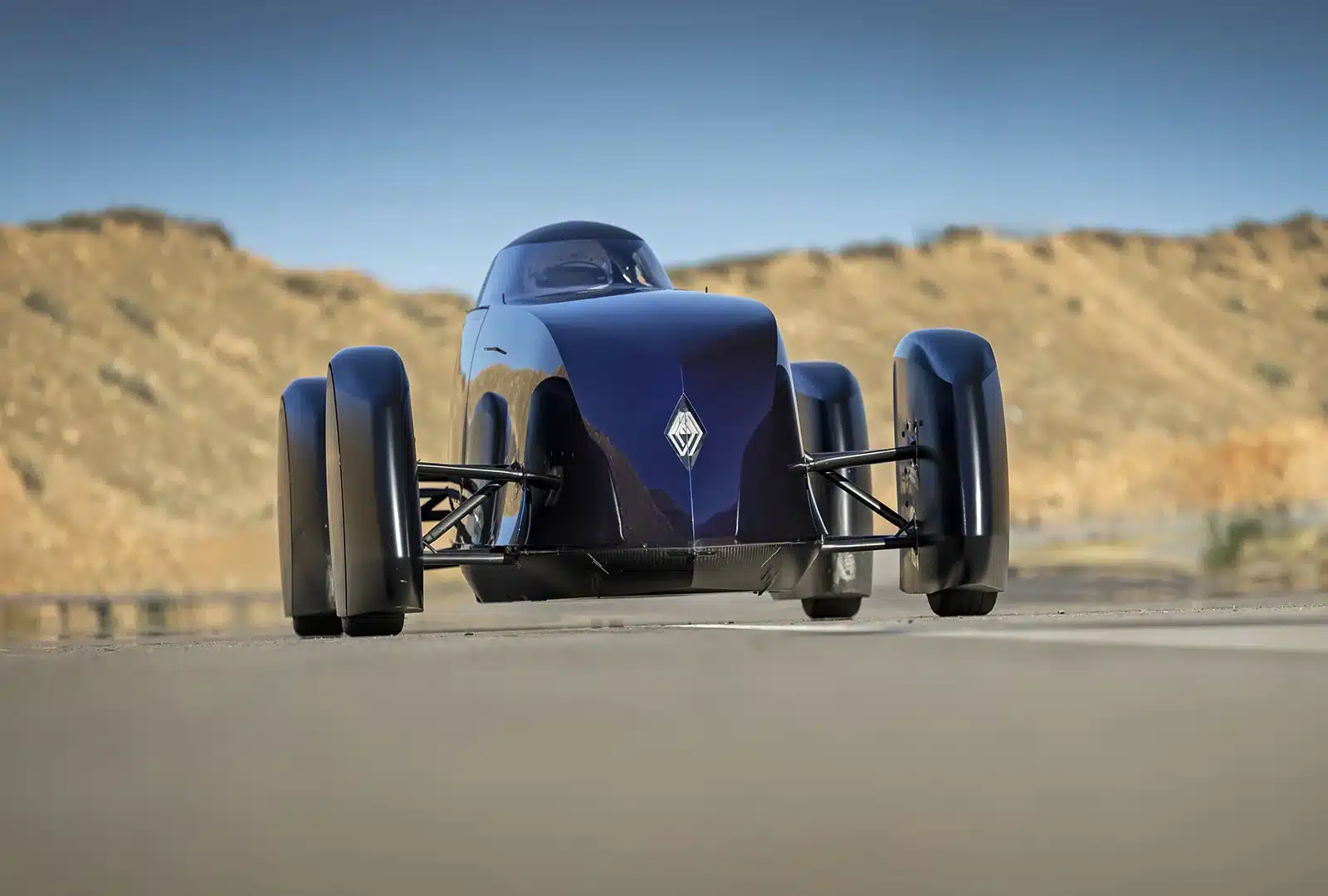
The Filante Record EV is best described as a ‘purpose-built electric efficiency demonstrator’.
It is not a concept car designed to tease styling cues or preview showroom features. Nor is it a one-off science project with no relevance beyond a press release.
Renault calls it a “laboratory on wheels”, and that description is accurate. Every aspect of the car exists to explore how far an electric vehicle can travel when energy loss is treated as the enemy.
The car was unveiled in early 2025, drawing immediate attention for its unusual proportions. Single-seat, ultra-low, narrow and shaped more like an aircraft fuselage than a conventional car, the Filante was never meant to blend in.
It was meant to slip through the air.
The 1,000km Question: How Renault Did It

The headline figure is striking: 1,000 kilometres on one charge. The detail is what gives it credibility.
The Filante Record EV used an 87kWh battery, identical in capacity to the pack found in the Renault Scenic E-Tech Electric. This was not a bespoke, oversized experimental unit. It was familiar hardware.
Drivers were tasked with maintaining speeds just over 68mph, completing the run in under ten hours. This matters. Many range records rely on crawling speeds that bear little resemblance to real-world use. Renault deliberately avoided that approach.
The result was an average energy consumption figure that would look implausible in a conventional EV. Yet it was achieved without magic, only discipline.
Aerodynamics: The Oldest Trick, Still the Most Powerful

Electric cars are often marketed around batteries and motors, but aerodynamics remains the most powerful efficiency tool available.
At motorway speeds, aerodynamic drag dominates energy consumption. Reduce drag, and range increases without touching the battery.
The Filante’s bodywork is shaped to minimise turbulence, with smooth surfaces, enclosed wheels and an aggressively tapered rear. There are no styling flourishes that do not serve a purpose. Even the driver’s seating position was chosen to reduce frontal area.
This is not revolutionary thinking. What is unusual is the willingness to pursue it so completely.
Rolling Resistance: The Quiet Saboteur

If aerodynamics is the headline act, rolling resistance is the supporting role that often steals the show.
Tyres matter more than most drivers realise. Compound, construction, width and pressure all influence how much energy is lost simply keeping a vehicle moving.
The Filante used specialised low-rolling-resistance tyres, paired with suspension geometry designed to minimise unnecessary deformation. The effect is subtle but cumulative. Over hundreds of miles, it becomes decisive.
Cyclists understand this instinctively. Drivers rarely think about it at all.
Weight Still Matters, Even in Electric Cars

Modern EVs have grown heavy. Batteries are dense, safety standards are demanding, and customers expect comfort. Weight increases energy consumption during acceleration and braking, even if it matters less at steady speeds.
The Filante is unapologetically lightweight. There is no excess, no redundancy. Everything has been questioned.
This does not mean production cars must become spartan. It does suggest that careful weight management remains essential, especially as EVs chase larger batteries rather than better efficiency.
Renault Filante Record EV vs Modern Electric Cars
To understand the Filante’s achievement, comparison helps.
| Vehicle | Battery | Typical Motorway Range | Weight |
|---|---|---|---|
| Renault Filante Record EV | 87kWh | ~621 miles | Ultra-light |
| Renault Scenic E-Tech | 87kWh | ~300–330 miles | ~1,900kg |
| Tesla Model S Long Range | ~100kWh | ~350–380 miles | ~2,100kg |
| Mercedes EQE | ~90kWh | ~330–360 miles | ~2,300kg |
The Filante is not meant to compete directly. It exists to show what is theoretically achievable with today’s technology, not to embarrass production cars.
But it does expose how much efficiency is currently left on the table.
A Name with Meaning: From Étoile Filante to Electric Record Holder

Renault’s decision to revive the Filante name is deliberate. The original Étoile Filante, built in 1956, was a gas-turbine-powered record car designed to explore new ideas, not sell units.
The modern Filante follows the same philosophy. It is an engineering statement, not a commercial one.
That distinction matters. It allows engineers to work without compromise, and it gives the results credibility.
Why This Record Actually Matters

Sceptics will point out that no one drives a single-seat EV shaped like a missile. They are correct. That is not the point.
What matters is that nothing about the Filante’s achievement violates the laws of physics or relies on unavailable technology. Every lesson learned is transferable.
This is how progress happens. Not through promises, but through demonstrated capability.
The Trickle-Down Effect: From Record Car to Showroom
Renault has been clear that the Filante Record EV exists to influence production vehicles. That influence is already visible.
Aerodynamic optimisation, improved thermal management, refined energy software and drivetrain efficiency all feed directly into road cars. These are not headline features, but they are the difference between acceptable and excellent real-world range.
This is particularly relevant for the UK market, where motorway efficiency often defines EV satisfaction.
Enter the Renault Filante Crossover: The Practical Expression

Alongside the Filante Record EV sits Renault’s new Filante crossover, positioned as a global flagship.
This is where theory meets reality.

The Filante crossover is not extreme, but it is intentional. Every design decision reflects a focus on efficiency, usability and long-distance comfort. Aerodynamics are carefully managed.
Weight distribution is considered. Powertrains are chosen for balance rather than bravado.
Renault is not chasing the fastest acceleration or the largest wheels. It is chasing confidence.
Powertrain Strategy: Electric and Hybrid Without Drama

Renault’s powertrain approach with the Filante crossover is refreshingly calm.
Electric versions benefit directly from lessons learned through the Filante Record programme, while hybrid options acknowledge that charging infrastructure remains uneven. This is not ideological. It is practical.
For drivers who cover long distances or lack home charging, hybrid remains a sensible stepping stone. Renault understands this, and builds accordingly.
Why This Strategy Feels More Mature Than Most

Many manufacturers talk about electric futures in absolutes. Renault’s approach feels more grounded.
It accepts that the transition is ongoing. It focuses on making electric cars better today, rather than promising perfection tomorrow.

That pragmatism is refreshing.
What UK Drivers Should Take From This
For UK motorists, the message is clear. Future Renault EVs should travel further on a charge, particularly at motorway speeds, without becoming heavier or more expensive.
That matters more than ever as electric cars move from novelty to default choice.
The Bigger Picture: Efficiency Is the Real Luxury

Electric cars are often sold as performance machines. Instant torque, rapid acceleration and large outputs dominate marketing.
Yet the Filante Record EV suggests that efficiency is the real luxury. The ability to drive long distances calmly, predictably and without anxiety is what most drivers actually want.
Renault appears to understand that.
Final Thoughts: Proof, Not Promises

The Renault Filante Record EV does not ask drivers to believe. It shows them.
By achieving 1,000km on a single charge at realistic speeds, Renault has delivered proof that the future of electric driving lies in intelligence, not excess.

Paired with the Filante crossover flagship, this is not a curiosity but a direction of travel. Renault is quietly building electric cars that make sense.
And in a market crowded with noise, that might be the most radical idea of all.
Images: Renault.com, www.press.renault.co.uk
Like What You’ve Read?
For more articles like this, receive our weekly e-newsletter, including partner deals and all things motoring, register your email below.
Please note: You cannot subscribe to Smart-Motoring unless you put a tick in the checkbox below to indicate have read and agreed to our privacy policy.